
Attala Sheriff Release Record Role
The official Attala County Sheriff page identifies Sheriff Curtis Pope and says the Sheriff serves as jailor and keeps a jail docket. That legal and recordkeeping role remains important after the county jail’s closure. The office can connect an Attala arrest to a booking, transfer, physical custodian, and local docket entry. It may also hold release authority or historical material.
The office at Ridgewood Circle is not the current physical jail gate. Current Attala detainees are ordinarily sent to Leake County under the interlocal arrangement. Do not direct someone there to wait for a release or collect a detainee. Call the Sheriff to learn where the person was sent, then contact the physical custodian for the exit transaction.
| Attala Sheriff may document | Physical custodian may document |
|---|---|
| Arresting agency and local charge | Actual booking into the detention facility |
| Jail-docket entry | Physical release or transfer timestamp |
| Transport or transfer destination | Exit code and facility code definition |
| Release authority held locally | Destination and hold status at departure |
| Historical former-jail records | Booking photograph created in its system |
Confirm Attala Sheriff Release Records
Start with a neutral identity worksheet. Record the full booked name, aliases, birth date, approximate arrest date, arresting agency, charge, and any known case or booking number. This is enough to route a search without gathering unrelated personal facts. Ask what record exists, not whether staff believe the person is released.
- Call the Attala Sheriff and identify the date and local matter.
- Ask where the person was booked and which agency held physical custody.
- Request the Attala jail-docket entry, arrest record, and transport or transfer destination.
- Ask whether Attala possesses a release authority, exit record, or historical booking photograph.
- Contact Leake when it held the person and request the physical exit timestamp, code, and destination.
- Match the exit reason to the proper Justice, Municipal, Circuit, or County Court record.
If the person entered MDOC, federal, immigration, or another county’s custody, follow the named receiving authority. The Attala County released inmates search sets out those broader routes. A transfer is not proof of community release.
Attala Sheriff Records Contact
The official county page supplies the office address, phone, and fax. It does not publish an online roster, release search, recent-release window, records-request form, fee schedule, official mobile app, or public hours. Use the verified contact below and call before visiting. Ask which submission method the records custodian accepts.
The official Sheriff page is captured here as the source for the agency and jail-docket route.
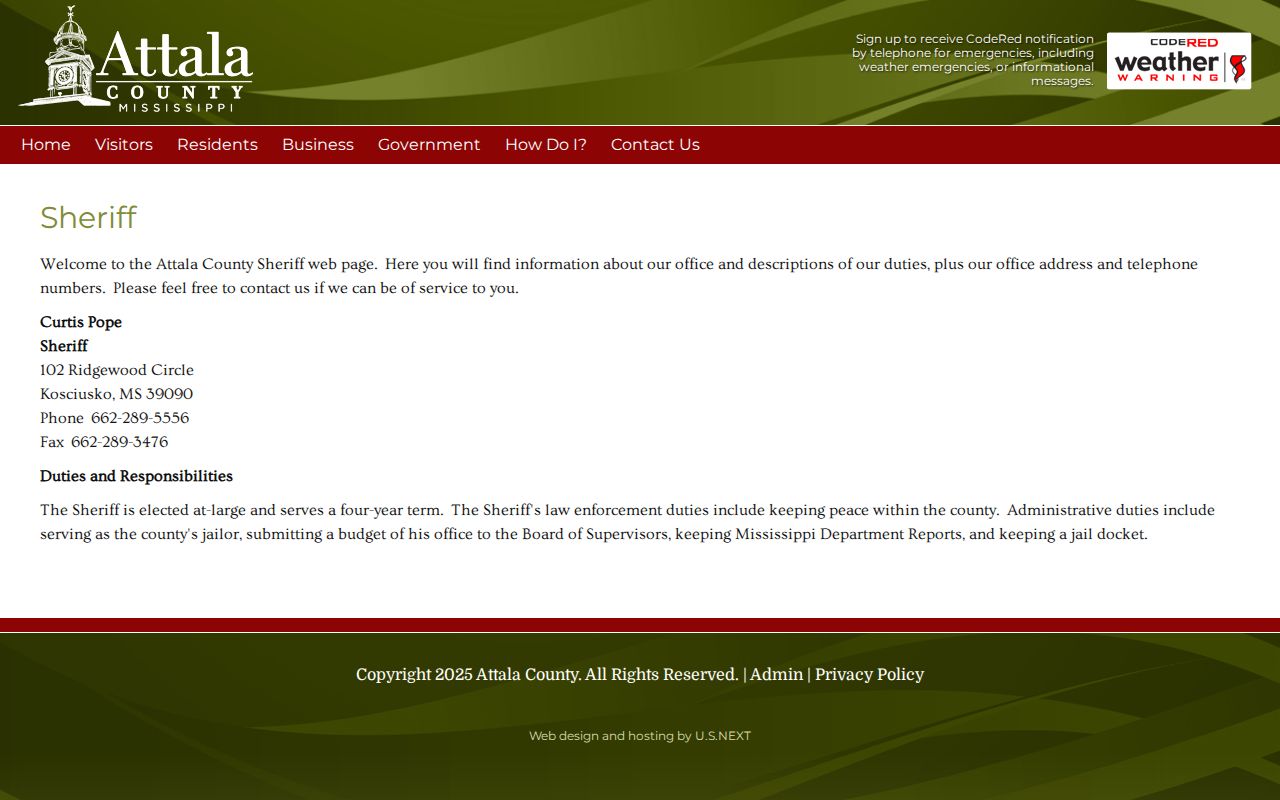
The image does not show a live roster or named-person release result. It confirms the local office that can identify the Attala record trail.
Attala County Sheriff’s Office102 Ridgewood Circle
Kosciusko, MS 39090
Phone: 662-289-5556
Fax: 662-289-3476
Telephone access is not guaranteed. Staff can require a written request, sufficient identifiers, lawful redaction, a fee estimate, or referral to the agency that created the requested field.
Attala Sheriff Jail-Docket Fields
The jail docket is not necessarily the same as a public roster. A roster tends to show people currently confined. A docket or booking-and-release log can preserve an event after the person leaves the current list. Ask for both the local docket row and any cross-reference to Leake.
| Field | Purpose |
|---|---|
| Booked name, alias, and birth date | Prevents a mistaken identity. |
| Attala arresting agency | Identifies who began the local record. |
| Booking and case numbers | Joins the custody and court files. |
| Charge and originating court | Routes the legal disposition. |
| Transfer date and destination | Shows which physical custodian to contact. |
| Release code, date, and time | Documents an exit if Attala holds that entry. |
| Receiving authority | Separates community release from another custody. |
Request the booking photograph separately. A photo links to the booking, but it cannot prove release or the court’s final outcome. Protected youth, medical, victim, investigative, security, sealed, and expunged material may be withheld or redacted.
Why Jail Closure Defines Sheriff Searches
Attala’s former Kosciusko jail closed in 2016 after safety concerns, and detainees were routed to neighboring Leake County. House Bill 1762 of 2017 authorized the two boards to enter an interlocal detention arrangement and ratified earlier official acts. This history defines the Sheriff page’s function: the office anchors the Attala arrest and docket, while the gate event may belong to Leake.
A stale search card can make the Sheriff’s legal title of jailor look like proof of an operating jail. It is not. The official Sheriff text documents a duty; the closure and legislation document current routing. A valid search must reconcile those facts rather than choose one and ignore the other.
The Leake County Correctional Facility release page covers the physical exit route. Use it after Attala identifies Leake as custodian. For older pre-closure records, remain with the Sheriff and ask which historical dockets, images, and logs were retained.
Attala Sheriff Records and Courts
A Sheriff record can show arrest, booking route, release authority, or transfer. The court record explains the legal result. A bond entry should be compared with the bond order. Time served or sentence completion should be checked against the judgment and recognized custody time. A transfer to MDOC should lead to a state admission or location record.
Use the correct court. Attala Justice Court handles county ordinance cases, specified traffic and DUI matters, and initial felony stages. Its official page says judges hold jail sessions three times per week to support an initial appearance within three days. A Kosciusko city charge may route to Municipal Court. Felony indictment, judgment, and sentence route to Circuit Court.
The Attala Circuit Clerk files criminal papers and keeps judgments for Circuit and County Courts. Request the docket sheet, final disposition, bond order, sentencing or amended order, probation order, revocation, and expungement order as needed. The court can authorize release without recording the exact time Leake processed the exit.
Request Attala Sheriff Release Records
A focused request can ask for existing jail-docket, arrest, booking, transport, release, and transfer records for a named person and narrow period. Include a birth date or booking number for identity. Seek the exact date and time, code and definition, destination, and photograph where public. Ask for an itemized fee estimate before extensive work.
The Mississippi Public Records Act broadly defines public records, permits reasonable actual-cost fees, and provides response rules. Section 25-61-5 generally calls for production within seven working days. If that cannot occur, the agency should explain in writing and state a production date, generally no later than fourteen working days absent agreement. Verify the current statute when submitting the request.
Do not require creation of a new report. Ask for an existing docket row or log export. If the Sheriff lacks Leake’s gate field, request the identity of the physical custodian. If a record no longer exists, ask which retention schedule applied.
Interpret Attala Sheriff Exit Codes
Release labels need context. Bond, recognizance, dismissal, court order, time served, sentence completion, and probation can lead to community release. Transfer to MDOC, another county, the U.S. Marshals Service, or ICE means the Attala or Leake custody episode ended but another custodian may have taken control. “Released to Attala” may also describe an agency handoff.
- Release
- The holding agency relinquished its custody under a stated code or authority.
- Transfer
- The person moved to another custodian rather than entering the community.
- Detainer
- A request or hold tied to another authority that can affect departure.
- Disposition
- The court’s legal resolution, which is distinct from the gate time.
- Expungement
- A court process that can restrict public access to qualifying records.
When records conflict, preserve both timestamps, match booking and case numbers, and ask the field’s creator to explain the code. Never convert absence from a current list into a claimed historical release.
Attala Sheriff Release Cross-Checks
MS SAVIN and VINELink can supply a recent status or alert for a specific person when the participating agency sends the record. Confirm consequential details with the feeding agency. The MDOC inmate search is appropriate only when the person entered state custody. A current MDOC location is not a county release to the community, and a tentative date is not an actual exit.
For federal or immigration movement, use the agency named in the transfer entry. A local release to the U.S. Marshals Service or ICE remains a custody handoff. For older county events, the Attala jail docket and court judgment may outlast a current screen. No single system covers every local, state, and federal path.
The most reliable Attala confirmation stack combines the Leake physical exit entry, the Attala legal disposition, and MDOC or MS SAVIN when state custody or supervision applies. The Sheriff’s Office is the essential first router, but it should never be described as the present physical detention facility.