
MDOC Attala Release Records
The Mississippi Department of Corrections is the statewide prison and corrections system. It is not the Attala County jail. A person enters the MDOC lane after a state commitment or another legal placement within MDOC authority. The statewide inmate search can follow that person across institutions and contracted or regional settings. County of conviction connects the sentence to Attala, while the location field identifies a current MDOC placement.
MDOC records use several dates. A Tentative Release Date is a computed expectation. A parole eligibility date permits consideration but does not promise release. An ERS date concerns earned-release supervision for an eligible person. A parole release date records transition to parole. A flat-time or discharge date concerns the sentence endpoint. Preserve each exact label.
Search MDOC Attala Offenders
Open the MDOC inmate search and use the name or MDOC number fields allowed by the live form. An identifier is safer than a name alone. Open a likely detail and compare date of birth, physical descriptors, offense, sentence date, sentence length, and Attala as county of conviction. Do not infer release from an absent result.
- Confirm that the Attala case produced commitment to MDOC.
- Search by MDOC number when available, or use the verified booked name.
- Match identity and Attala county of conviction before reading status fields.
- Read location, unit, location-change date, and Tentative Release Date together.
- Check the parolee route when community supervision is plausible.
- Request an official release or discharge record when the public result is incomplete.
A current institution or unit means the person is still placed in the state system. A parolee result may show county, supervising officer, and flat-time date. If no state record exists, return to Attala and Leake because a person who bonded from a local charge and never entered MDOC falls outside this search.
MDOC Attala Search Fields
The public detail format provides useful identity and calculation context. Fields can change, and a record may not display every item. The observed format includes a photograph and sentence-specific data as well as location information. A photograph is an MDOC identification image, not proof of release and not necessarily the original Attala or Leake booking photo.
| Field group | What it establishes |
|---|---|
| Name, MDOC ID, birth date, descriptors | Helps match the correct person. |
| County of conviction | Connects the sentence to Attala County. |
| Entry date and location | Shows admission context and current placement. |
| Unit and location-change date | Documents where and when the listed placement changed. |
| Offense and sentence fields | Shows each recorded term and overall structure. |
| Tentative Release Date | Reports MDOC’s current projection, which can change. |
The representative MDOC detail below demonstrates the field layout. It is used only to show the public record structure and must not be read as a claim about the named individual.
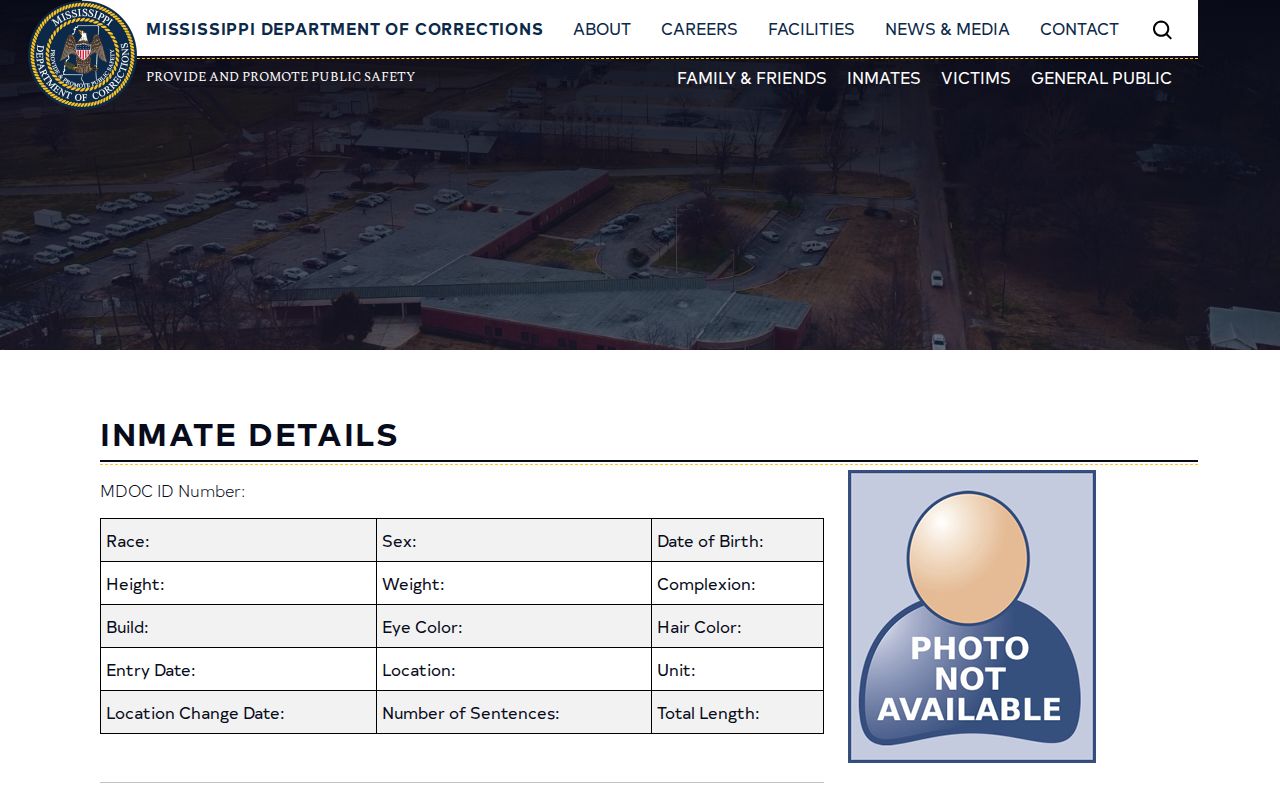
The field image shows why the agency word “Tentative” must remain attached to the date. An actual release needs a later event record.
MDOC Attala Release Calculations
MDOC records staff compute terms and establish parole, earned-release, tentative-release, and discharge dates. Eligible county-jail time can affect the calculation. Other inputs include concurrent or consecutive sentence structure, sentence amendments, new terms, disciplinary forfeiture, program eligibility, parole action, revocation, escape time, and detainers.
Mississippi Code section 47-5-138 authorizes earned time for covered sentences under stated conditions. For many covered post-June 1995 sentences, the statute describes four and one-half days for each thirty days served and caps the reduction at fifteen percent. It also permits forfeiture and addresses earned-release supervision. Section 47-5-139 lists exclusions.
Do not apply the common “about 85 percent” shorthand to an individual. The offense, sentence date, statutory exclusion, conduct record, and MDOC computation all matter. ERS can place an eligible person in the community while inmate status and MDOC jurisdiction remain. That is release from confinement, not final discharge.
Note: Capture a tentative date with the date viewed, then replace it with the actual release or discharge record after the event.
MDOC Release Records Contact
Use central records for an official time sheet, actual release date, release type, discharge certificate, final status, or archived supervision dates. The facility or assigned unit may answer current operational questions, but the statewide Records Department is the stronger route for sentence and release documentation. Ask for existing documents, not a newly created explanation.
PO Box 24388
Jackson, MS 39225
Phone: 601-933-2889
Email: MDOCRecordsDepartment@mdoc.state.ms.us
MDOC Central Office
301 North Lamar Street
Jackson, MS 39201
Phone: 601-359-5600
Include the person’s name, MDOC number, Attala as county of conviction, and a focused date range. Seek records sufficient to show admission, time computation, actual release or discharge, release mechanism, final status, and public supervision dates. Ask for an itemized estimate and segregable public portions. Privacy, security, victim, and investigative rules may limit some material.
Mississippi Code section 47-5-157 addresses written discharge or release and specified release assistance for MDOC offenders. It should not be generalized to every Attala county detainee. When the state document is the goal, ask for the certificate or existing written release record by name instead of relying only on a vanished search result.
MDOC Attala Supervision Transitions
Mississippi separates the parole decision from field supervision. The State Parole Board makes parole decisions under governing law. MDOC Community Corrections supervises parolees, probationers, people on ERS, and other authorized statuses. The Attala Probation & Parole Office is the local verification point when the statewide record assigns the person there.
A Board grant can precede the physical release date. MDOC’s public guidance says processing, a viable residence plan, travel arrangements, conduct, and unresolved legal barriers can affect the event. The strongest proof is a release or discharge certificate or official records response. A coherent change from an inmate record to a parolee record and local office assignment is supporting evidence.
| Record | Question answered |
|---|---|
| MDOC inmate detail | Where is the person placed and what tentative date is shown? |
| Parole Board action | What decision did the Board record? |
| Parolee detail | What community status and county are reported? |
| Release certificate | When and by what mechanism did confinement end? |
| Discharge record | When did the sentence or MDOC jurisdiction end? |
Attala’s Route Into MDOC
The old Attala County Jail closed for safety reasons in 2016. Local legislation in 2017 formalized an agreement to keep Attala inmates in Leake County and ratified prior official acts. This history determines the proper custody lane. An Attala arrest can create an Attala sheriff and court record while the physical booking and exit record sit in Leake.
If the Leake facility record states transfer to MDOC, the person did not enter the community at that point. Match the receiving authority and look for the state admission. The Attala Sheriff remains the local route for its jail-docket and transfer entry. An MDOC offender may stay at a regional facility under state authority, including a setting that also contains county detainees. The legal population and authority, not the building alone, control the release record.
The Attala-Leake interlocal authority explains why searches must move from the closed local jail to Leake and then, when commitment occurs, into MDOC. It prevents a transfer record from being mislabeled as a community release.
A regional-facility name does not settle which system owns the release. Ask whether the person was held as an Attala county detainee or as an MDOC offender. The first route leads to the local court and Leake exit transaction. The second leads to MDOC sentence computation, release paperwork, and any Community Corrections record.
MDOC Attala Release Alerts
Mississippi SAVIN and VINE can report MDOC custody changes such as transfer, return to custody, escape, abscond supervision, and release. The Registration Link can carry a county-level notification registration into the later MDOC record after commitment. That feature is especially relevant when an Attala detainee begins in Leake custody and then enters the state system.
An alert is timely but derivative of MDOC data. Confirm the date and release mechanism with MDOC when the distinction matters. A notification of transfer or a new location is not release to the community. The Office of MS SAVIN provides 601-359-5759 during business hours and a twenty-four-hour representative at 888-967-7284.
The Attala County release search covers county docket, Leake exit, court disposition, MDOC, and notification records in one custody sequence. Federal and immigration custody remain outside MDOC and require their own agency sources.