
Leake Facility Attala Release Routes
The Mississippi Department of Corrections facility listing classifies Leake County Correctional Facility as a regional facility. It is operated locally through the Leake County Sheriff and can hold more than one legal population. An Attala detainee can be there before trial or under a county sentence. An MDOC offender can be there under state authority. The record source changes with that legal status.
An Attala detainee may leave to the community after bond, recognizance, dismissal, time served, sentence completion, or another court order. The person may instead transfer to MDOC, another county, federal authority, or immigration custody. A remaining hold can delay community release. Ask what authority ordered the exit and where the person went.
The facility name alone cannot identify the controlling system. Two people at the same Carthage site may have different record custodians because one remains in a local pretrial case while another serves an MDOC sentence. Confirm the legal population before using a date or status. That step also prevents an MDOC “Tentative Release Date” from being applied to a county detainee whose release depends on bond, a local sentence, or a court order.
| Exit shown | Meaning | Next source |
|---|---|---|
| Bond or recognizance | Possible community release after local processing | Leake exit record and Attala bond order |
| Dismissal or court order | Legal authority to release on the Attala matter | Attala case disposition and Leake timestamp |
| Time served or completion | Custodial term recorded as complete | Judgment, recognized custody time, and exit code |
| Transfer to MDOC | State custody continues | MDOC inmate record |
| Other agency destination | Local custody ended, but another custody may begin | Named receiving authority |
Confirm Leake Facility Attala Releases
A precise question tests history, not just present custody. Instead of asking only whether a person is there, ask whether the person was booked on an Attala matter around a stated date and whether the public booking record shows a release or transfer timestamp, reason code, and destination. This guards against spelling errors, a completed transfer, and a current screen that no longer retains the row.
- Collect the booked name, aliases, birth date, approximate arrest date, charge, and known booking or case number.
- Ask the Attala Sheriff which agency booked and physically held the person.
- Call Leake and request the Attala-linked booking number and legal population.
- Seek the exact exit date and time, code, code definition, destination, and unresolved hold status.
- Match bond, dismissal, time served, or sentence completion to the proper Attala court record.
- Follow any MDOC, federal, immigration, or other-county transfer to the named system.
The Attala County released inmates search provides the broader named-person route when the custody lane is uncertain. Record Mississippi events in Central Time and do not invent an hour when a source reports only a date.
Leake Facility Release Contact
The official facility page is the verified contact source for the physical custodian. It does not publish a distinct Attala release roster, fixed release hours, weekend processing rules, family waiting instructions, a public records form, or a fee schedule. Call before visiting and ask for the records custodian when staff cannot provide historical information by telephone.
The government listing linked above is captured below. It supports the facility classification, address, and telephone used for the Attala physical-exit route.
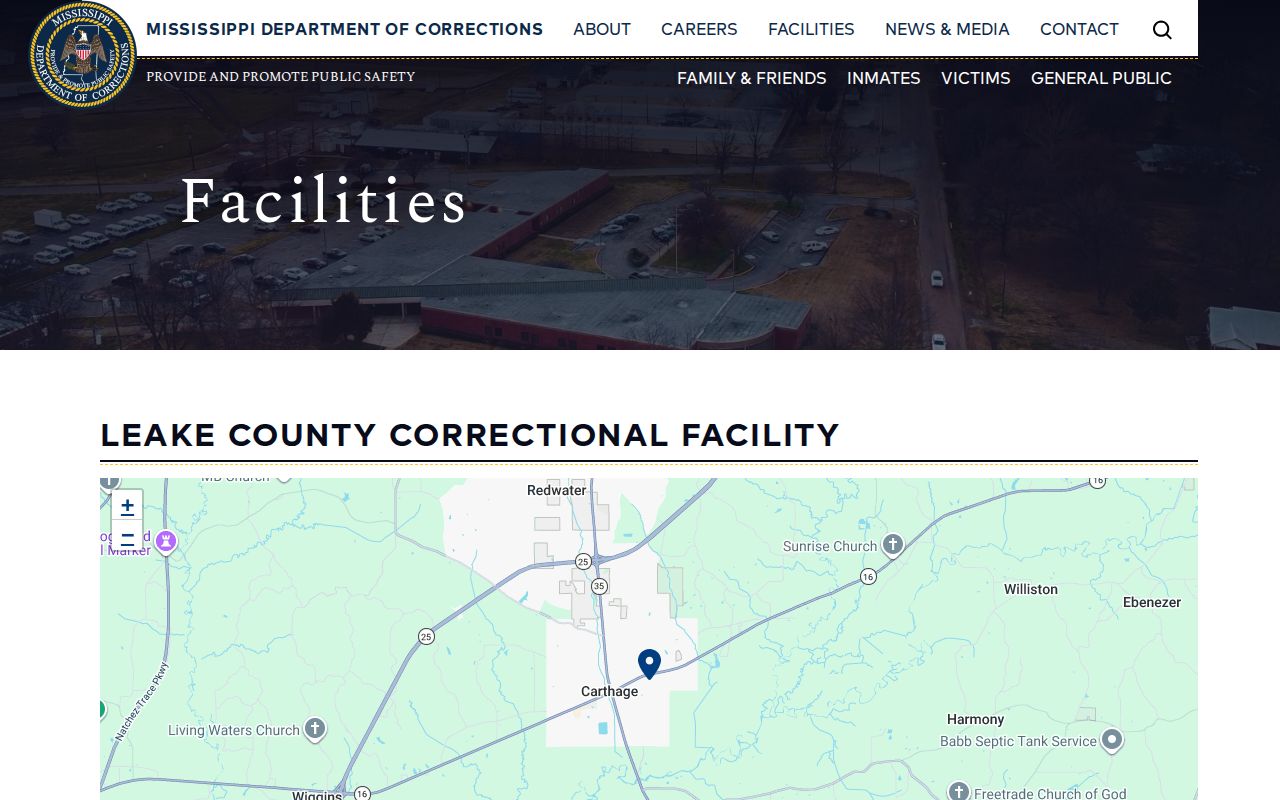
The screenshot does not prove any named person’s custody or release. It identifies the agency contact for records created at the facility.
Leake County Correctional Facility399 C.O. Brooks Street
Carthage, MS 39051
Phone: 601-298-9003
Confirm the submission route before mailing a request. No verified public hours should be inferred from a directory or search result.
Leake Facility Release Record Fields
The physical exit record should be requested field by field. Identity details prevent a false match. The code and destination show whether the person entered the community or moved to another custodian. A booking photo identifies the original booking image but cannot establish current status or case outcome.
| Field | Reason to request it |
|---|---|
| Name, alias, and birth date | Confirms the correct person. |
| Booking number and Attala agency | Links Leake custody to the local matter. |
| Booking and exit timestamps | Defines the custody interval. |
| Charge, court, and case number | Routes the legal explanation to the proper Attala court. |
| Release code and definition | Preserves the custodian’s exact reason. |
| Destination or receiving agency | Distinguishes release from transfer. |
| Hold flags at exit | Shows whether another authority affected departure. |
Some fields may be redacted or withheld under law. Protected youth, medical, victim, security, investigative, sealed, and expunged data require care. Ask for segregable public portions rather than assuming the entire booking file is open or closed.
Why Attala Releases Route Through Leake
Facility history changes the present search. Attala closed its unsafe Kosciusko jail in 2016 and began using neighboring Leake County for detainees. House Bill 1762 of 2017 expressly authorized the two county boards to enter an interlocal detention agreement and ratified earlier official acts under it. That history explains why an Attala legal matter can produce a Leake booking and gate record.
For this facility page, the history means Leake is not a random fallback. It is the physical custody starting point for an Attala detainee held there. Yet Attala remains vital because the Sheriff can identify the arrest and transfer, and the Attala court can explain the legal authority. The source split should be preserved in every request.
A search card using the obsolete Attala jail name can hide this route. Verify a facility claim through an official county or MDOC source, then ask which agency created the exact field at issue. The gate time normally belongs with Leake; the Attala case disposition normally belongs with the Attala court.
Leake Facility Populations Change Records
Regional facilities can contain local pretrial detainees, county-sentenced people, and MDOC offenders. “Released from Leake” does not have one universal legal meaning. An Attala pretrial detainee who posts bond follows a local court and county record path. An MDOC offender physically at Leake follows state sentence computation and discharge records. A transfer between those populations is not freedom.
Read location and legal authority together. If the exit says MDOC, use the MDOC inmate search and compare name, MDOC number, birth date, county of conviction, current location, and sentence fields. MDOC’s “Tentative Release Date” is prospective and changeable. It is not a historical gate confirmation. For an actual state release or discharge, request the written MDOC record.
MS SAVIN and VINELink can provide a specific-person status or alert when a participating agency supplies the record. The alert is derived from agency data and may lag. Confirm exact time and destination with the source custodian.
Match Leake Exits to Attala Courts
A release reason of bond should correspond to a bond order or docket event, though the order and physical exit can occur at different times. Time served or sentence completion should align with a judgment and the custody time the court recognized. A dismissal or acquittal is a legal outcome, while Leake’s exit entry establishes when custody actually ended.
Attala Justice Court handles early felony proceedings and several county-level matters. A Kosciusko municipal charge follows the city-court route. A felony may move to Circuit Court for indictment, plea or trial, judgment, and sentence. The Attala Circuit Clerk keeps filings and judgments for Circuit and County Courts, while Mississippi Electronic Courts offers remote access for covered cases.
Request named documents: the docket sheet, bond order, final disposition, sentencing or amended order, recognized-custody-time order, probation or post-release order, revocation, and any expungement order. Not every historic, justice, sealed, youth, or nonelectronic record will appear online.
Request Leake Attala Release Records
Send a narrow request to both agencies when the record crosses the county line. Ask Attala for the jail-docket entry, arrest or booking material, transport destination, and release authority it possesses. Ask Leake for the physical booking, exit timestamp, code and definition, receiving authority, holds resolved at exit, and booking photograph. Ask each office to identify the other custodian when it lacks a field.
Mississippi’s Public Records Act allows reasonable actual-cost fees and sets response rules. Invite an itemized estimate, provide enough identifiers, and request segregable portions. Do not demand a custom report the system cannot make. For a recent period, ask whether an existing release-log export can be supplied with clear start and end times.
No official Attala or Leake 24-hour or 72-hour release feed was verified as of the research date. A timestamp-bounded records request is the accurate substitute. It should state whether transfers are mixed with community releases and when the export was generated.
When Attala and Leake return different timestamps, do not choose the one that appears more convenient. Preserve each agency’s label and creation date, confirm that both records concern the same booking, and ask whether one time reflects an order, transport, data entry, or physical departure. The release timestamp should remain in Central Time. A later correction should be added to the timeline without erasing the earlier response.