
Federal Attala Release Records
The Federal Bureau of Prisons operates the sentenced federal prison system. Its public locator can retain a record after release and show “Released” with a date or “Not in BOP Custody.” Those labels speak only to BOP custody. A person can remain under federal supervised release, be held by another authority, or appear in a different federal custody lane.
Attala County has no identified federal prison. The BOP page is therefore a statewide and nationwide search route for a federal case, not a local facility page with an Attala release gate. A county record that says “released to BOP,” “USMS,” or “ICE” documents a handoff unless the receiving agency later records a community release.
Search Federal Attala Releases
Use the BOP Inmate Locator when the person was a sentenced federal prisoner or otherwise within the locator’s scope. A number search is the strongest route. The form supports BOP register, DCDC, FBI, and INS numbers. A biographical search uses name and other fields offered by the live interface.
- Confirm that the local record or federal docket points to BOP custody.
- Search by the verified federal identifier when one is available.
- Otherwise enter the full name and match the listed biographical fields.
- Read the status, facility, and date as a single result.
- Distinguish “Released,” “Not in BOP Custody,” and “In Transit.”
- Use BOP records and the federal court docket when the result needs deeper confirmation.
The official locator screenshot below shows the federal search interface. It demonstrates the available route, not a named person’s custody or release. Open the current BOP locator because form labels and explanatory text can change.
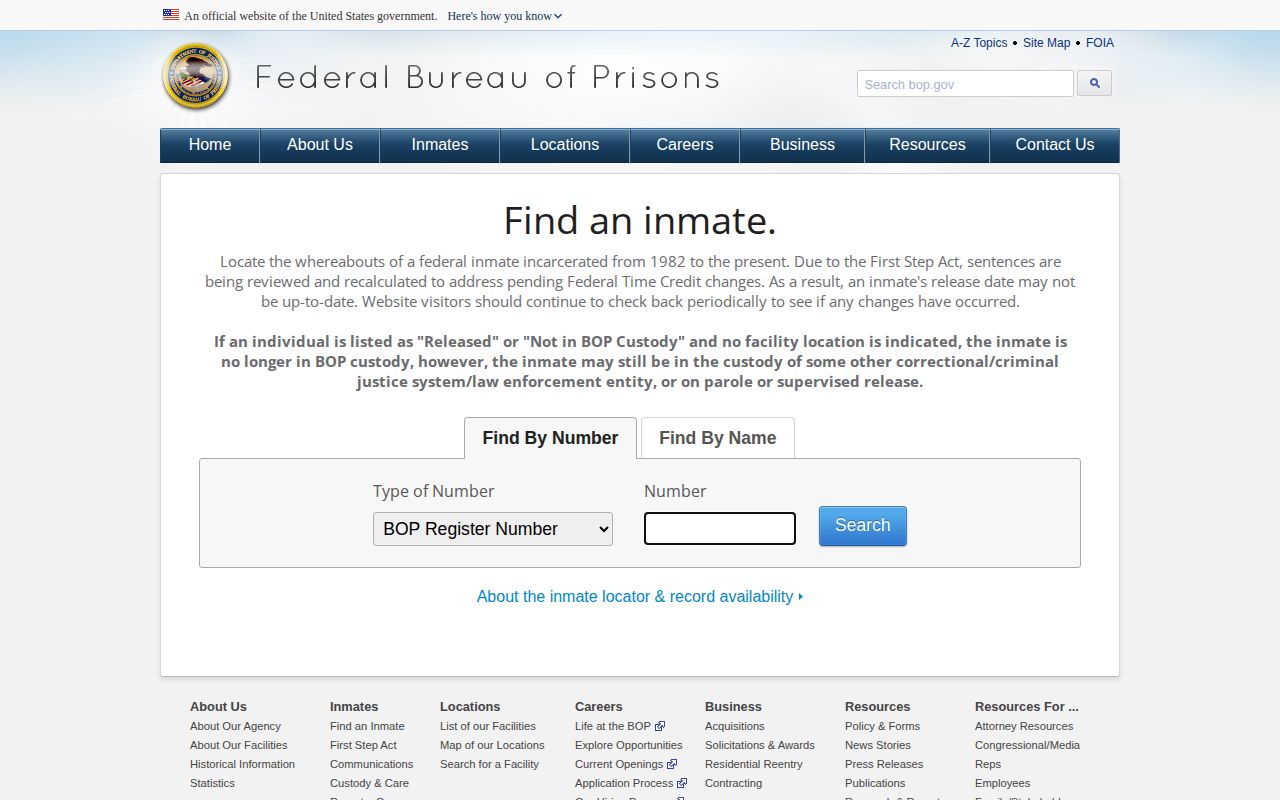
The result must be tied back to the federal identifier and case. A matching name without a matching number or other facts can point to the wrong person.
Read Federal Attala BOP Results
BOP explains that a past date with no listed facility can mean the person was released on that date and is no longer in BOP custody. A result may use “Released” or “Not in BOP Custody.” “In Transit” means movement and is not proof of release. A future date is projected and can change through recalculation or another legal event.
| BOP result | Proper reading | Next check |
|---|---|---|
| Facility listed | The record reports a current BOP placement. | Confirm facility and update date. |
| In Transit | The person is moving within the federal system. | Wait for the later placement or event record. |
| Future release date | The date is prospective and may change. | Review the federal sentence and BOP computation. |
| Released with past date | BOP reports that its custody ended on that date. | Check the federal docket and any supervision record. |
| Not in BOP Custody | The person is not currently held by BOP. | Determine whether another authority or status applies. |
The locator generally covers federal inmates from 1982 forward and updates daily. Many older records require archival research. Some pretrial, witness, or contempt custody can also appear, so the federal docket remains important for the legal basis and outcome.
Note: A BOP release date does not prove release from an earlier Attala or Leake booking; each custodian records its own event.
Federal BOP Release Record Requests
Use BOP FOIA for records beyond the locator. Identify the person, register number, approximate dates, federal court and district, and a narrow set of documents. Useful items can include admission and release dates, sentence-computation data, release status or destination where public, and the record that explains the locator entry.
BOP Inmate Locator
BOP Freedom of Information Act
No federal prison is identified in Attala County.
Use the current official BOP contact instructions for submission.
Third-party privacy exemptions can limit the response. Proof of identity or consent may be required for detailed personal records. Ask for segregable public portions and a fee estimate rather than assuming the full prison file can be disclosed. A federal court docket provides the judicial detention or release authority, while the BOP movement record supplies the custodial event.
USMS Attala Custody Transfers
The United States Marshals Service manages federal pretrial and court-related movements, often through contract detention facilities. A federal defendant may remain in USMS custody without becoming a sentenced BOP prisoner during that stage. That is why a BOP no-result response cannot settle every federal custody question.
A Leake exit entry naming USMS means county custody ended through transfer to federal authority. Search the federal court docket for detention, bond, remand, sentencing, or release orders. For the movement itself, use USMS FOIA. A focused request asks for dates the named person entered and left USMS custody, the custody disposition or receiving authority, the associated facility, and the federal court or district.
Privacy, law-enforcement, security, and other exemptions may restrict the response. USMS has no general public historical released-inmate locator that works like BOP’s. Do not substitute the BOP locator when the evidence points only to federal pretrial custody.
ICE Attala Transfer Checks
Immigration custody is separate from BOP and USMS criminal custody. The ICE Online Detainee Locator System searches by A-number and country of birth or exact biographical data. Official ICE guidance says it includes certain people currently detained and people released from ICE custody within the prior sixty days. It does not search minors and is not a permanent immigration release history.
An immigration detainer asks the local agency for advance notice and continued custody for up to forty-eight hours after the person otherwise would be released so ICE can assume custody. If ICE takes custody, the Leake record may show an exit while ODLS shows detention. The person did not enter the community. If ODLS has no match, possible reasons include a spelling mismatch, age exclusion, release outside the display period, another custody lane, or incomplete data.
ICE’s Detention Reporting and Information Line is 888-351-4024, Monday through Friday excluding holidays, from 8 a.m. to 8 p.m. Eastern, with language assistance. Individual legal questions about a detainer require qualified counsel. The locator provides navigation, not a ruling on status.
Attala’s Closed Jail Federal Lane
The former Attala County Jail closed in 2016, and later legislation authorized the interlocal arrangement that places Attala detainees in Leake County. This local history matters in a federal search because the first transfer record may be created at the Leake gate even though the case began with an Attala arrest or court matter.
Trace the chain without skipping agencies. The Attala Sheriff identifies the arrest and where the person was sent. The Leake facility record documents the physical exit and names a receiving authority. A federal docket explains the federal court order. USMS records cover many pretrial movements, BOP covers its custody, and ICE handles immigration detention. An entry that simply says “other agency” should be clarified before choosing a locator.
The Attala-Leake custody authority explains why an obsolete “Attala jail” result is not a reliable starting point. It also prevents a local transfer from being mistaken for the later federal release.
A missing BOP result cannot close that chain. The person may have been in USMS pretrial custody, may be outside the locator’s date coverage, or may require a number search to separate a common name. Likewise, absence from ICE ODLS can reflect exact-name mismatch, excluded categories, or a release outside the locator’s recent window. Preserve the Leake destination, federal case number, and any agency identifier before requesting records. Those details show which federal office can confirm the next movement and keep a handoff from being described as release to the community.
Compare Attala Release Systems
No one search covers county, state, federal, and immigration custody. Match the record to the authority that held the person at the time in question. A court order can explain why custody should change, but the holding agency records the actual movement.
| Authority | Public route | Release proof |
|---|---|---|
| Attala and Leake | Sheriff, physical custodian, and Attala court | Local exit transaction plus disposition |
| MDOC | Inmate and parolee searches | MDOC release or discharge record |
| BOP | BOP Inmate Locator | BOP release record and federal docket |
| USMS | Federal docket and FOIA | USMS movement or disposition record |
| ICE | ODLS and detention information line | ICE custody or release record |
The Attala County released-inmate search starts with the local identity and custody worksheet. If MDOC rather than a federal agency received the person, continue through the Mississippi DOC release route.