
Attala Release Date Meanings
One date cannot answer every release question. The court sets legal terms. The holding agency calculates and processes custody. The Mississippi State Parole Board decides parole where the law assigns that role, while MDOC computes state terms and supervises many people after confinement. For an Attala arrest housed at Leake County Correctional Facility, the Attala case record and Leake gate record may sit in different counties.
A pretrial detainee has no sentence end date. Bond may be posted, charges may be dismissed, or a judge may issue a release order. Processing can still wait on another hold. A county-sentenced person’s date depends on the judgment, sentence start, jail credit, lawful local credits, and later orders. A state offender’s public detail may show MDOC’s exact label, “Tentative Release Date.” That is an expected date, not proof of exit.
- Tentative release date
- MDOC’s changeable estimate based on its current computation.
- Parole eligibility date
- The point when consideration may begin, not a promise of release.
- ERS date
- A possible earned-release-supervision date for an eligible person.
- Discharge date
- The endpoint of the sentence or agency jurisdiction.
Choose Attala’s Release Date Lane
First decide whether the person is in local, state, federal, or immigration custody. The correct source follows the custodian, not just the county named in the case. Current Attala detainees are ordinarily housed in Leake County because the former Kosciusko jail closed. A felony commitment can then move the person into MDOC. That movement is a transfer, not a community release.
| Custody lane | Best date source | Key caution |
|---|---|---|
| Attala pretrial case | Attala court order plus Leake exit record | No fixed release date may exist before the court acts. |
| County sentence | Sentencing order and custodian calculation | Do not apply MDOC earned-time rules by default. |
| MDOC sentence | MDOC detail, time sheet, and release certificate | The public date is tentative until release occurs. |
| Federal sentence | BOP locator and federal sentence records | MDOC does not calculate federal time. |
| Other-agency hold | Receiving agency and transfer record | Leaving Leake may not mean entering the community. |
Note: “Attala” as county of conviction connects the sentence to the case, not to the offender’s current physical location.
Find Attala Projected Release Dates
Use identifiers before calculating anything. Gather the full booked name, date of birth, approximate arrest date, court case number, booking number, and MDOC number if one exists. The public MDOC inmate search can be searched by the fields the live form permits. Open the detail result and compare identity, county of conviction, offense, sentence date, current location, and sentence length.
- Confirm whether the person is pretrial, county-sentenced, or committed to MDOC.
- For MDOC, search by MDOC number or name and match Attala as county of conviction.
- Record the exact “Tentative Release Date” label and the date when the page was viewed.
- Retrieve the sentencing order and any amended sentence or jail-credit order from the proper Attala court.
- Ask the custodian or MDOC Records for the controlling time calculation when the public fields do not reconcile.
- After release, replace the estimate with the actual release or discharge record.
For a local matter, call Attala Sheriff at 662-289-5556 to identify the booking and physical custodian. If Leake held the person, ask its facility at 601-298-9003 for the calculation or release transaction it maintains. The full Attala County release-record route helps distinguish the sheriff’s jail docket from a current roster and joins the physical event to the court disposition.
Attala MDOC Tentative Date
The MDOC detail format includes identity, MDOC ID, photograph, entry date, location, unit, location-change date, sentence count, total length, each offense, sentence date, county of conviction, and Tentative Release Date. Read those fields together. A future date beside a current MDOC location does not mean the person has left custody. A parolee result may instead show the supervising county, officer, and flat-time date.
The representative MDOC field-layout example is useful only to show where the label appears. It must not be used to profile the named person or imply that person has been released.
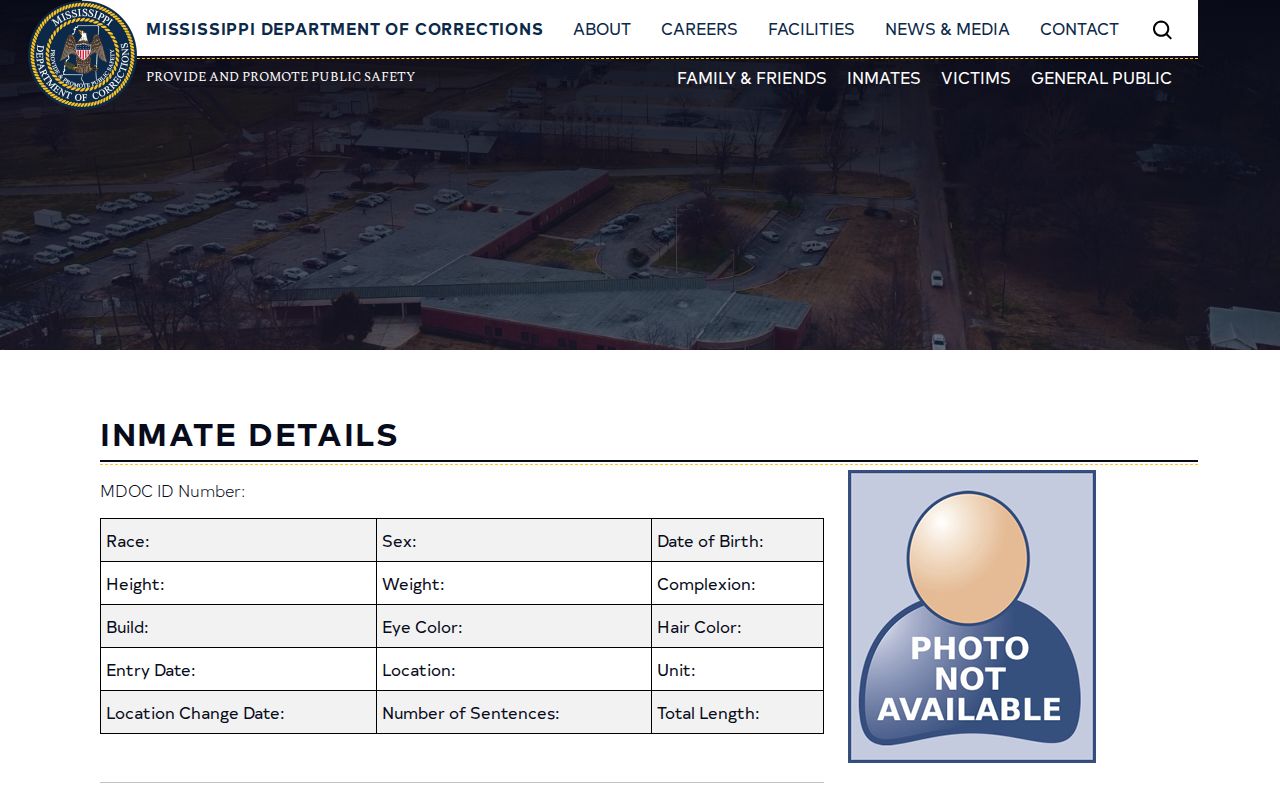
The screenshot shows why the agency’s own wording matters. Record the field as tentative, with the capture date, instead of restating it as a guaranteed gate day.
Attala Release Dates and Earned Time
Mississippi Code section 47-5-138 governs key parts of MDOC earned time. For covered sentences imposed for offenses after June 30, 1995, subsection (5) authorizes four and one-half days of earned time for each thirty days served when MDOC finds compliance with conduct and performance requirements. The reduction is capped at fifteen percent of the term, subject to statutory exceptions. That is the source of the common “about 85 percent” shorthand.
The shorthand is not a safe personal calculation. Section 47-5-139 excludes listed categories from earned time, while other law may address separate credits. Sentence date, offense type, program eligibility, and MDOC findings matter. Section 47-5-138 also permits forfeiture for serious rule violations. Its earned-release-supervision provision can put an eligible person in the community while retaining inmate status and MDOC jurisdiction until sentence expiration.
County jail time is different. A local misdemeanor sentence is controlled by its judgment, commencement date, awarded jail credit, lawful county policy, and release orders. No source supports copying MDOC’s fifteen-percent framework onto every Leake-held Attala county sentence. Ask for the actual calculation sheet and the authority used.
Why Attala Release Dates Move
A tentative date is recalculated when an input changes. Some changes shorten the remaining term. Others extend it or delay physical release after the expected day. The reason should be tied to a court order, agency entry, time sheet, Board action, or hold, not guessed from a web result.
Record the date before and after a change, plus the source that displayed each version. Then look for the document that altered the calculation. An amended Attala sentence belongs with the court file, an earned-time adjustment belongs with MDOC’s time record, and a hold should identify the authority that will receive the person. A changed projection is not proof of an error by itself. It is a signal to reconcile the sentence, credits, supervision decision, and custody destination before treating any day as final.
| Factor | Possible effect | Record to check |
|---|---|---|
| Jail-time credit | Eligible pre-sentence custody may reduce time remaining. | Judgment, credit order, MDOC calculation |
| Concurrent or consecutive terms | Sentence structure can change the total endpoint. | Sentencing and amended orders |
| Earned-time gain or forfeiture | Credits may advance a date or loss may move it later. | MDOC time sheet and conduct record |
| Court amendment or new sentence | A lawful order can alter the controlling term. | Court docket and MDOC recomputation |
| Parole or ERS action | May permit supervised community release when conditions are met. | Board action, MDOC and supervision record |
| Detainer or hold | Can cause transfer to another authority instead of community release. | Exit destination and receiving-agency record |
| Revocation or escape time | Can change credit and custody calculations. | Revocation order and agency time record |
Attala MDOC Date Hierarchy
MDOC distinguishes ERS, tentative release, and maximum release dates. An ERS date reflects a statutory calculation for an eligible person, but MDOC says it does not automatically cause release. Near that point, the person may propose a residence for evaluation by a probation or parole agent. Conduct, disqualifications, approved plans, and unresolved holds can intervene.
The MDOC family and friends FAQ states that release processing can take thirty to forty-five days, a discharge certificate must be received, a case manager advises the person of the date, and travel plans are verified. It also says parole and ERS dates are not guaranteed. These are state-prison practices. They do not establish a release timetable for an Attala detainee held under county authority at Leake.
The proof hierarchy starts with a release or discharge certificate or official MDOC response. A consistent transition from the inmate record to the parolee record and Attala Community Corrections is useful next. A Board grant alone ranks lower because administrative conditions can remain. A VINE alert is timely but derives from the agency feed.
Note: Release to supervision ends confinement but may leave MDOC jurisdiction in place; discharge is the stronger sentence endpoint.
Attala Courts and Release Dates
The correct Attala court depends on the case. Justice Court handles county matters within its authority and the initial stage of felony cases. Its jail sessions can produce an early bond or release order before a felony reaches Circuit Court. A Kosciusko city charge may belong in Municipal Court. Circuit Court records later felony filings, judgments, sentence terms, jail credit, revocation, and amended orders.
Ask for documents by name. Useful records include the docket sheet, bond order, final disposition, sentencing order, amended sentence, jail-credit order, probation or post-release order, and revocation. A “case closed” label is not a release date. The order may explain why custody should change, while Leake’s exit transaction records when staff actually carried it out.
The Sixteenth Circuit Mississippi Electronic Courts portal is a remote channel for covered electronic cases. Not every older, Justice Court, municipal, youth, sealed, or nonelectronic matter will appear. The Attala Circuit Clerk remains the custodian for covered court records and can route a request when the case number or court is uncertain. Keep an order’s effective date separate from the date it was entered on the docket.
Verify Attala Actual Release Dates
For MDOC documentation, contact the Records Department at P.O. Box 24388, Jackson, MS 39225, telephone 601-933-2889, or MDOCRecordsDepartment@mdoc.state.ms.us. Identify the person by MDOC number and Attala as county of conviction. Request records sufficient to show admission, actual release or discharge, release type, final status, the time computation, discharge certificate, and public supervision dates. Ask for segregable public portions and a fee estimate.
For county custody, seek the Attala jail-docket or transfer entry and the Leake physical exit transaction. Record the timestamp in Central Time. If a source gives only a date, do not invent an hour. If a court order, alert, and gate record differ, keep each source date and ask the creator to explain the discrepancy.
MS SAVIN can monitor a pending custody change, and the resolved Attala VINE Inmate Check explains registration and the county-to-MDOC Registration Link. Once the exit occurs, the dated custodian record supersedes the earlier estimate. A release to another agency remains a transfer unless the receiving record shows a later community release.